


A split bone from the collection of the Hungarian Natural History Museum has helped scientists understand how the Deinotherium, an extinct giant proboscidean, could grow to such enormous sizes. French and Hungarian paleontologists recently published their findings in a study. Not only scientific analyses, but also an archival newsreel proved useful in the research.
Dr. Camille Bader (first author of the study), a researcher at the Muséum National d'Histoire Naturelle (Paris), examined fossil remains of ancient proboscideans in museum collections. During her visit to the Hungarian Natural History Museum (Hungarian National Museum Public Collection Centre), she noticed a huge, unidentified femur in the collection.
The fragmentary femur, split lengthwise in two, turned out to belong to a Deinotherium giganteum, an ancient proboscidean from the Miocene epoch that could reach a height of 4 meters at the shoulder and a body mass of up to 13 tons. The species was characterized by its distinctive downward-curving tusks. The scientific significance of this rare limb fossil lies in its fragmented state: because it was split in two, its internal structure could be studied without the use of costly CT scans, offering the first insights into how this proboscidean’s bone microanatomy adapted to its enormous weight.
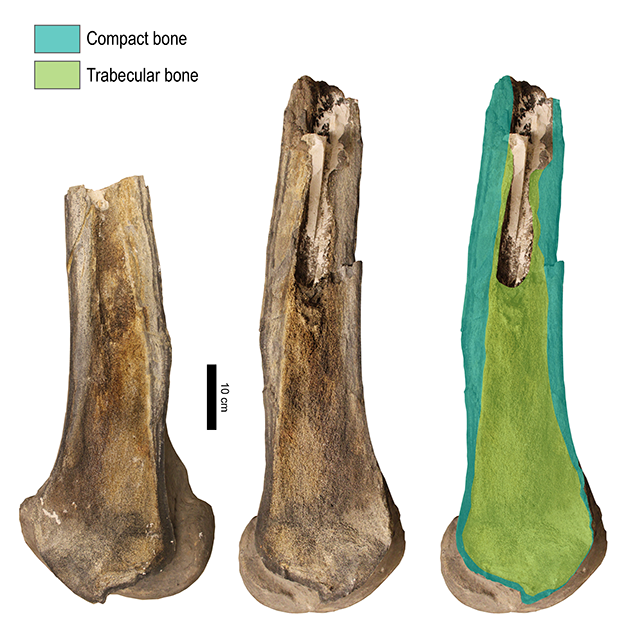
Parts of the split femur of Deinotherium giganteum, and the distribution of compact and trabecular bone inside it
The study revealed that the inner structure of the femur shows expected signs of adaptation to a large body mass, such as bone trabeculae oriented orthogonally to the ground to help distribute the mechanical load. However, the Deinotherium's femur shows a thicker bone wall compared to smaller proboscideans (like some mammoths or living elephants), which may be related to differences in overall body mass or to different adaptations for weight-bearing within this group.
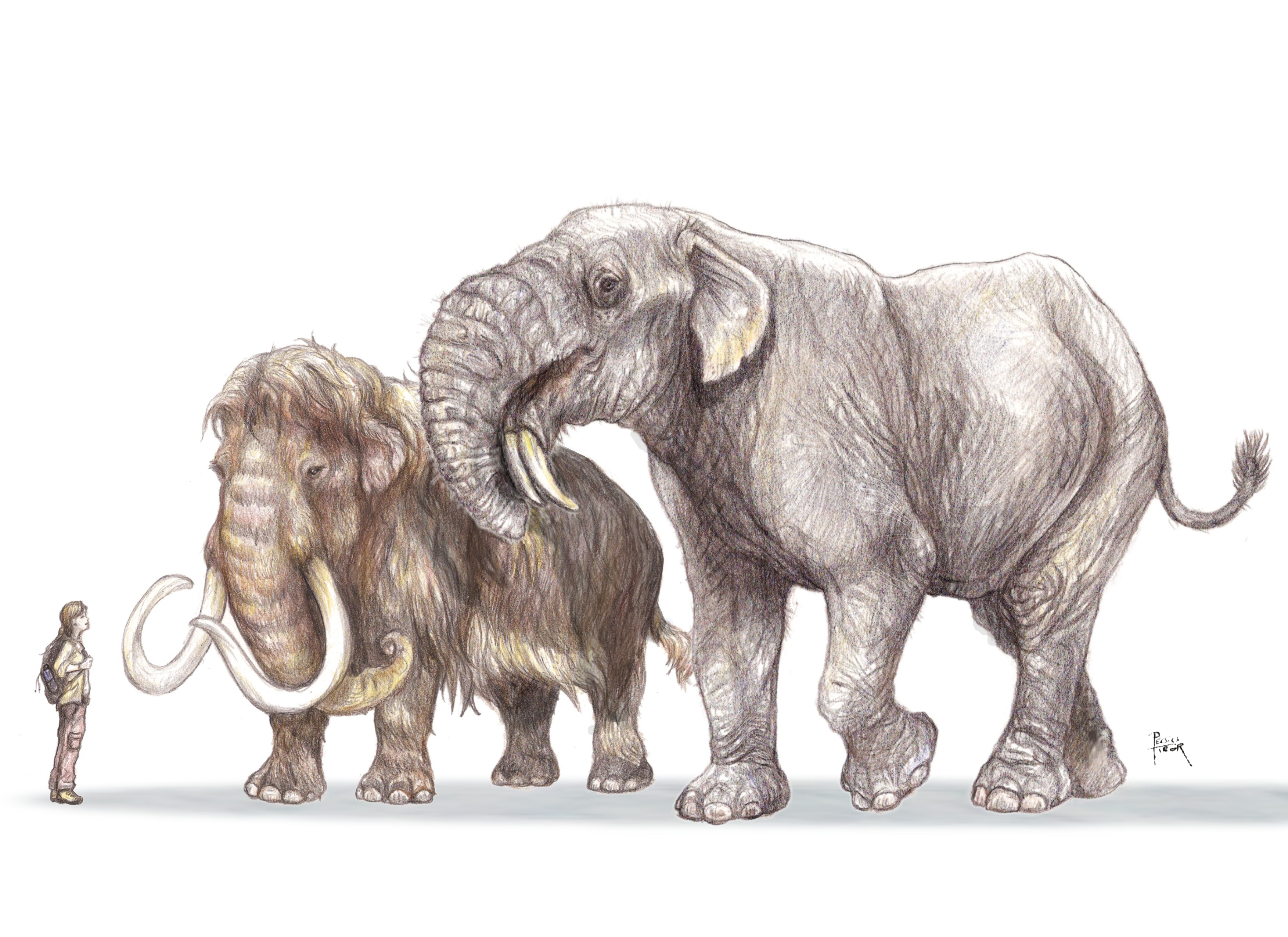
The giant Deinotherium giganteum, and a woolly mammoth (Mammuthus primigenius) compared to a human (~170 cm) (Art: Tibor Pecsics - @griffworkshop5)
Due to the lack of surviving records, the exact locality and story of the bone had been forgotten. However, Martin Segesdi, a PhD candidate at Eötvös Loránd University, and Dr. Mihály Gasparik, the curator of the collection (co-authors of the study), set out to trace its origins. They were able to identify the limb bone in its intact state in archival photographs of the former exhibitions of the museum, as well as in a newsreel clip from 1961 (from 0:39, filmhiradokonline.hu). Moreover, these sources led them to locate additional associated bones and fragments within the collection. Based on the artifact labels that can be read from the old photos, it was established that the Deinotherium originated from Hurezu Mare, Satu Mare County (Romania), and its age could be dated to approximately between 11.6 and 6 million years ago.
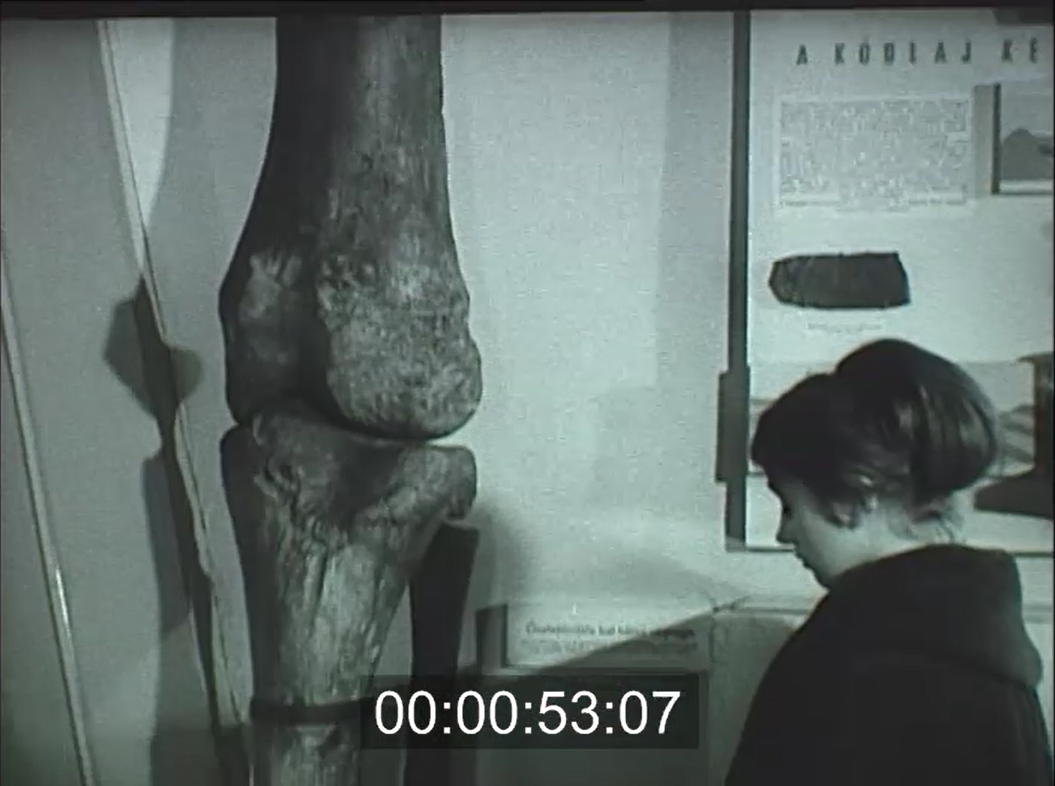
The Deinotherium hind limb bones (still intact) in an archival newsreel footage from 1961 (from 0:39, filmhiradokonline.hu). The bones were once on display at the Hungarian Natural History Museum’s exhibition 'The History of Earth’s and Life’s Evolution'
This study is a reminder that behind the doors of natural history collections lie countless untold stories, waiting to shed new light on our planet’s past.
The study is available at:
(Cover picture: Reconstruction of the giant Deinotherium giganteum (Art: Tibor Pecsics - @griffworkshop5)