


The League of European Research Universities held its next meeting with the seven Central European universities on September 9-10, 2022. The participants renewed and strengthened their cooperation and discussed the latest research and educational guidelines.
Representatives of the Central European partner group of the League of European Research Universities (LERU) and the rectors of the seven Central European universities (CE7) meet every six months to explore how to better support joint national and European interests and what good practices could be developed jointly. The collaboration, established in 2016, was born from the recognition that European research universities face similar challenges, which affect every area of the interconnected activities of universities - education, research, and social engagement.
The most recent semi-annual meeting took place at Charles University in Prague. The participants signed a partnership agreement to renew and strengthen their cooperation. With the agreement, the two groups demonstrated their ongoing commitment to improving the framework conditions for research and education within Europe and promoting joint research and education. It also drew the attention of decision-makers to the fact that more unites research universities than divides them. The participants also prepared a list of short-term priorities for EU institutions, which can be read at the following link. The agreement is based on the proposal outlined by the rectors of the CE7 universities at their meeting at Eötvös Loránd University on June 22, 2022.
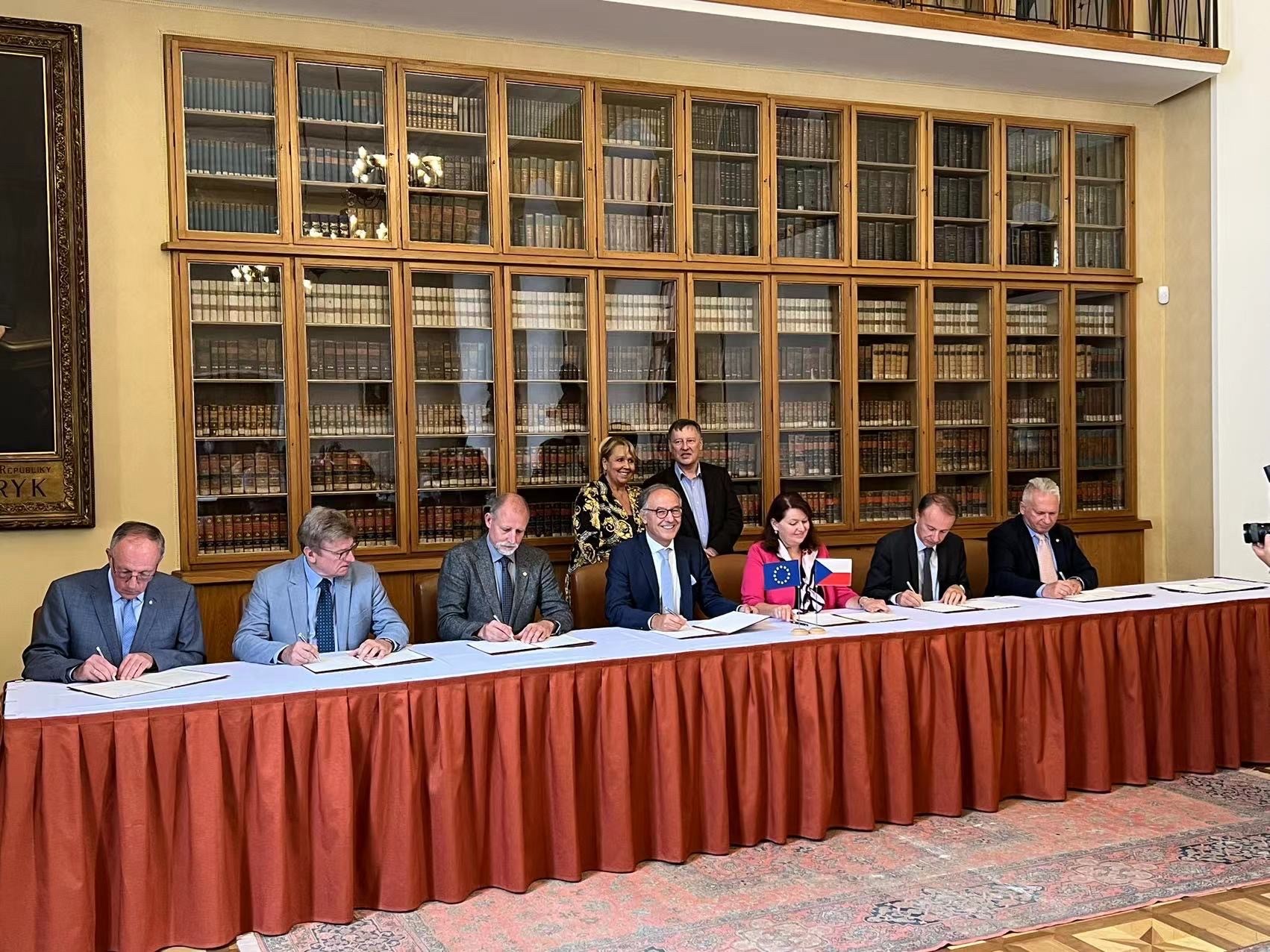
Before signing the partnership agreement, representatives of LERU and CE7 discussed the latest research and educational guidelines in a full-day program. They were joined by Ivana Maletic (European Court of Auditors) and Manuel Aleixo (DG Research and Innovation / European Commission), who spoke about the "widening" of Horizon 2020 and Horizon Europe.
Eötvös Loránd University was represented at the event by László Borhy, Rector, Imre Hamar, Vice-Rector for International Affairs, and Péter Sziklai, Vice-Rector for Scientific Affairs.