

Every science has its rulebook. Particle physics’ rulebook is known as the Standard Model - a rather succinct set of equations and experimental results that manage to describe everything in the universe down to its smallest moving parts and the vast in-between. Seventeen elementary particles and three forces (sans gravity), and remarkably, just three particles (the up quark, the down quark, and the electron) build nearly everything you ever see: your morning cup of coffee, the distant mountains, and even us humans.
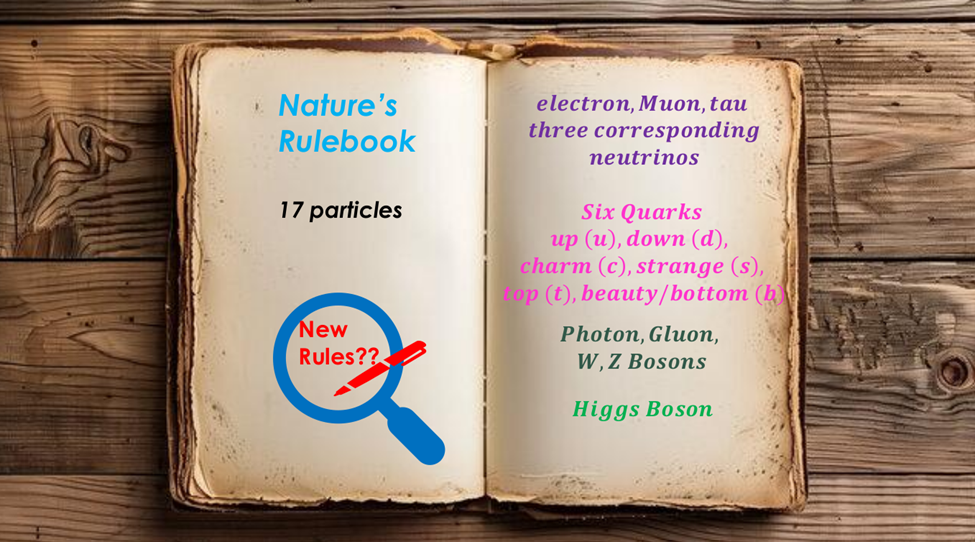
Postulated over more than fifty years, this rulebook has worked astonishingly well. Every careful measurement we have thrown at it has come back saying: yes, the prediction was right. Often right to one part in a million.
But the rulebook is incomplete. It says nothing about persistent mysteries: dark matter, which outweighs ordinary matter five-to-one in the cosmos. It cannot explain why the universe is full of matter and almost no antimatter, when the Big Bang must have created equal amounts. There must be missing pages, but we do not yet know where in the book to find them.
That is where my work begins. I look for what physicists call rare decays: events that happen only once in a million, or once in a billion collisions. The Standard Model predicts exactly how rare these events should be. If we count them carefully and the answer comes out even slightly off, that disagreement is a crack in the book: a hint of New Physics.
To create such events, we use the Large Hadron Collider at CERN, a 27-kilometre ring under the French–Swiss border where protons are smashed at almost the speed of light. The LHCb experiment is one of the four major experiments at CERN, and ELTE is one of its participating institutes.
Inside the LHCb experiment, forty million collisions happen every second. That is far more than any computer can store. So how do we catch the rarest of them? With triggers: ultra-fast filters that, in microseconds, decide which collisions look interesting and which to throw away. Without them, no discovery is possible. The LHCb experiment is currently finishing its Run 3 data taking.
As a core member of the ELTE-LHCb group, I contributed to designing the triggers to select interesting events. I am also working on rare decays of a short-lived particle containing the beauty quark, called the “Lambda_b” baryon (a cousin of the ordinary proton and neutron). The rulebook says that nature should treat electrons and muons (the heavier cousins of electrons) exactly the same. My job is to check whether it really does. Even a small mistreatment of one over the other would be a giant clue to what lies beyond.
The Standard Model is one of the greatest achievements of human beings. But somewhere in its pages, there are loopholes. Finding them, one rare event at a time, is what we are here to do.