

In October 2021, thousands of people in Oman refreshed their phones repeatedly as Cyclone Shaheen approached the country’s northern coast. Roads disappeared under floodwater, communication networks weakened, and families searched social media for updates faster than television could deliver them. Shaheen became one of the strongest cyclones to strike northern Oman in more than a century, causing deaths, infrastructure damage, and economic losses estimated at nearly OMR 200 million.
But beyond the destruction, the cyclone revealed another challenge: in a digital age, disasters move at the same speed as information. During crises, people no longer wait for tomorrow’s newspaper or evening broadcasts. They turn to smartphones, hashtags, and instant alerts. This transformation raises a critical question: can artificial intelligence (AI) help governments communicate faster, more accurately, and more humanely during disasters?
Today, AI is rapidly changing crisis communication worldwide. Machine-learning systems can analyze weather data, detect misinformation, translate emergency warnings into multiple languages, and identify public concerns through social media patterns in real time. Research on disasters such as Hurricane Sandy showed that AI-assisted analysis of millions of social media posts helped identify evolving public needs during emergencies.
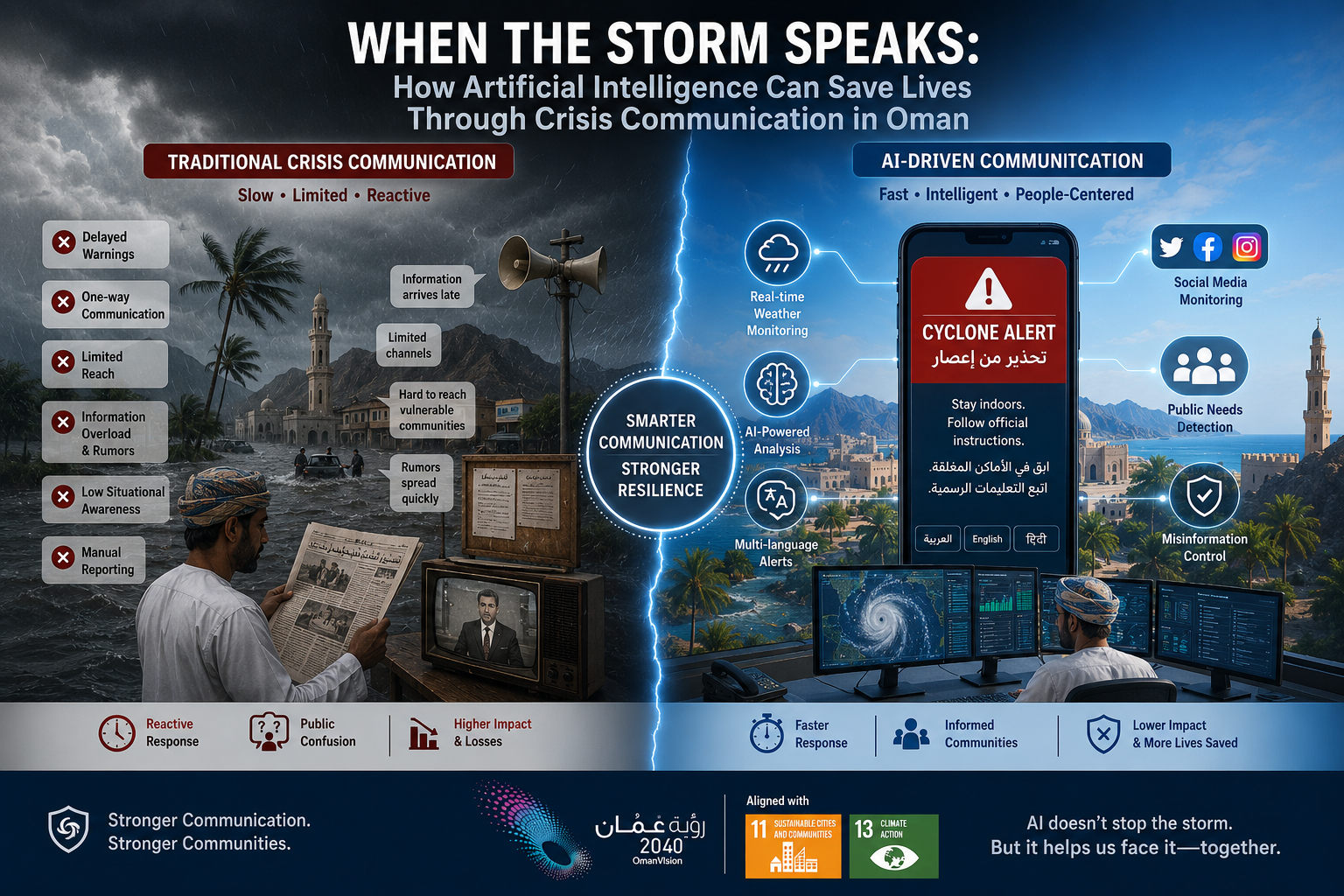
For Oman, this technology could become essential. The country faces increasing climate risks linked to extreme weather events in the Arabian Peninsula. Cyclone Shaheen demonstrated how quickly floods, road closures, and communication disruptions can escalate. AI-driven communication systems could support faster evacuation messaging, detect areas where people urgently need assistance, and reduce panic caused by rumors and fragmented information online.
Importantly, AI is not only about technology; it is about resilience. Under Oman Vision 2040, digital transformation, smart governance, and sustainable development are central national priorities. AI-supported crisis communication directly contributes to these goals by strengthening public safety and improving institutional preparedness. It also aligns with the Sustainable Development Goals of the United Nations, especially SDG 11 (Sustainable Cities and Communities) and SDG 13 (Climate Action).
However, technology alone cannot solve every problem. AI systems can also spread biased or inaccurate information if they are poorly designed or lack transparency. Effective crisis communication still depends on public trust, credible institutions, and ethical digital governance. Recent discussions across the Gulf region highlight how governments increasingly rely on coordinated digital communication during emergencies, yet transparency and public engagement remain major challenges.
The future of crisis communication in Oman may therefore depend on a partnership between humans and intelligent systems. Imagine an AI platform connected to meteorological centers, emergency authorities, and social media networks simultaneously. Instead of citizens searching for scattered updates during the next cyclone, personalized warnings could instantly reach vulnerable communities in Arabic, English, and other commonly spoken languages. Emergency agencies could identify misinformation before it spreads and allocate rescue resources more efficiently.
When the next storm arrives, artificial intelligence may not stop the winds or the floods. But it could help societies respond with something equally powerful: clarity, trust, and preparedness. In an era of climate uncertainty, the ability to communicate quickly and intelligently may become one of the most important forms of disaster protection.