

Nitrogen is a crucial chemical element to make proteins and DNA in all living beings, including humans and Earth’s atmosphere. In soil, without nitrogen, no plants can grow. Without plants, no food on our table, unless you only consume animal-driven products. Even so, without nitrogen, there is no wheat growing in the field to feed agricultural animals. You get the idea of how important nitrogen is for our survival. However, the power of nitrogen to feed us has been exploited to the point that it is now one of the main causes of catastrophic pollution of the planet.
The nitrogen fertilizer era
It all started in the 1960s during the Green Revolution. The demand for crop production increased due to a growing population. To meet this demand, one of the earliest inventions in agricultural science was the chemically engineered manufacturing of nitrogen-based fertilizer in the early 1900s. Developed by German scientists Fritz Haber and Carl Bosch, it drastically escalated the speed at which synthetic fertilizer is produced. We are not talking about just big production, but MEGA production. For instance, since the introduction of nitrogen fertilizer, the maize production in the US increased by 556 times in less than a century. The use of nitrogen fertilizer helped feed the growing world population. Accordingly, synthetic fertilizer production became so profitable that in 2022, three global fertilizer companies recorded the revenue of USD $40 billion, equivalent to the European country, Estonia’s GDP.
Disturbing the natural cycle of nitrogen
However, there was a cost to this rapid revolution. Earth used to have its own nitrogen cycle. Since human intervention, the natural cycle of nitrogen has been disturbed in the biosphere. Nitrogen exists in different forms depending on its usage in air, water, and soil. Too much nitrogen in the soil causes nutrient imbalance in trees, damaging forest health and its ecosystem. Agricultural use of synthetic fertilizer causes redundant presence of nitrogen, which enters streams and rivers into the ocean, affecting terrestrial and aquatic organisms. Too much nitrogen in the air causes greenhouse gas emissions, affecting the air quality and the ozone layer.
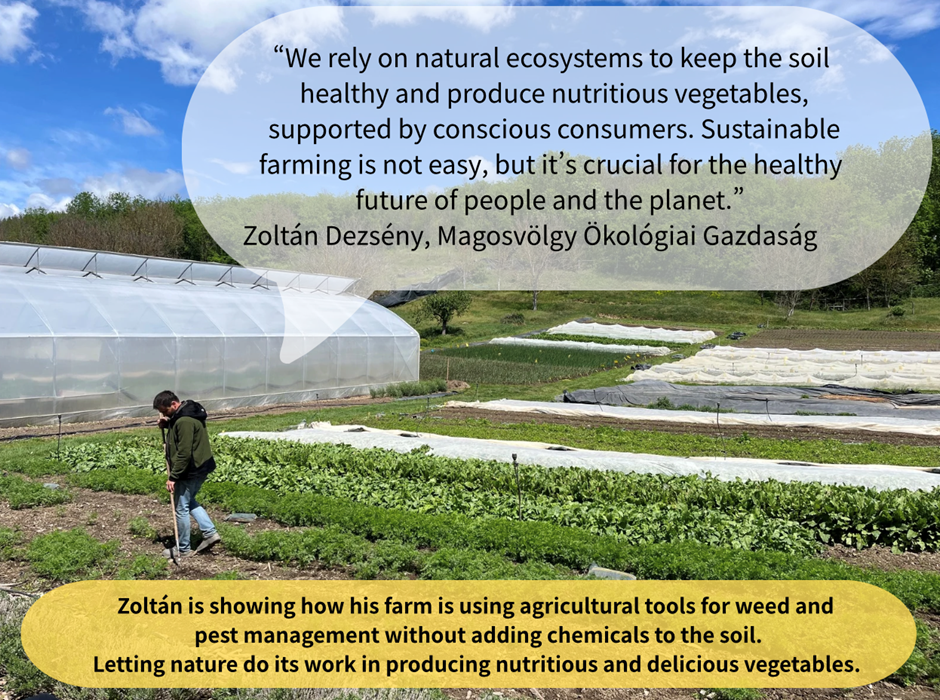
Power of conscious farmers and consumers
The good news is that it is possible to recover the organic soil and the natural balance of the nitrogen cycle. In Hungary, Community-Supported Agriculture, Magosvölgy Ökológiai Gazdaság is the example. It is an ecological farm, feeding over 150 households in Budapest. The producer Zoltán Dezsény believes that, without using synthetic fertilizers or other chemicals, farming is possible to operate based on the natural cycle of the ecosystem. Magosvölgy is possible because the farmers care about environmentally sustainable practices. It is also possible because there are consumers who care and support an unconventional way of farming for human and planet health.